Wednesday, December 27, 2017

Using Mo to Teach Character and Setting to Kindergarteners


Of course, I love Mo Willems!  Let me count the reasons why:

#1: Kids love Mo's books and I love whatever kids love ( well, maybe not the cardboard pizza served in the cafeteria.)

#2:  Mo's books make everyone laugh.  Laughter is good for the heart and the brain, right?

#3:  Mo's books help us all think about friendship, patience, conflict resolution, growing up--the stuff of life, really.  

#4:  These books are outstanding for teaching reading and writing!

So, how do I use Mo Willem's books in my classroom?  You are cordially invited to read on !

In our district, we have selected the theme, All About Books, for the middle trimester of kindergarten.  That's about 13 weeks to delve into these Common Core Standards for reading literature:

I like to devote 3/5 of the time to reading and writing fiction, and 2/5 to informational text/writing.  We just got a science curriculum, STEMscopes, this year so some of my informational reading/writing is related to science topics.  This middle trimester also includes Thanksgiving, Martin Luther King Day, and Presidents' Day, so these are wonderful social studies topics.  But informational text/writing is the subject of other posts.... back to Mo!

I have found author studies to be a great way to teach about fiction.  By studying the work of one author over the course of a few weeks, certain features and concepts become clear to students.  Mo's books are great for teaching many concepts of print, character, and setting:
Parts of a Book


A number of years ago, I found a version of this song in a copy of The Mailbox magazine.
For a week or so, we all sing the song while holding a Mo Willem's book and pointing to the parts as we sing about them.

Describing a Character


Have you ever noticed how the illustrations in the Pigeon series as well as the Elephant and Piggie series are purely of characters?  There are NO indications of the settings!  So, these two series are perfect for focusing students' attention on characters.  After reading several of the Pigeon books, my kindergarteners are ready to begin describing the outside and inside of Pigeon.

The outside/ inside construct makes sense to 5 and 6 year olds.  With just a little guidance, they can use color and size words to describe the outside of Pigeon.  Describing what a character is like on the inside is more challenging.  As teachers, we have to expand our students' vocabulary.  I find that using emoticons is very helpful and fun!  I also use this as an opportunity to teach opposites which effectively doubles their vocabulary. 

I have made several dozen emoticon cards which can be used to describe characters in many books.
Someday I may offer them on TpT!
I pass out an emoticon to each student and everyone has a turn saying something like

"Pigeon is not sweet." 
or
"Pigeon is grumpy."

I write a few of their sentences in predictable chart form, as well.

Comparing Characters

After reading a few Elephant and Piggie books and describing both characters, we set out hula hoops as Venn Diagrams.  One by one, students place the emoticons in the Venn Diagram according to their opinions.  We don't always agree on the traits of a character but I think the debate is worthwhile, too!  Once again, I write some of their statements in predictable chart form.


"Gerald is  grumpy but Piggie is  sweet."

"Both of them are funny."


Settings
In the Knuffle Bunny series, we first encounter settings.  Some kindergarteners notice the difference right away!  They are intrigued by the black and white photo illustrations and the pops of color that are the characters.


As we read, we practice labeling the settings.  I emphasize the use of position words when identifying a setting:

"The setting is in a classroom."
"The setting is on a plane."


I have also made quick sketches of the settings and written phrases on index cards.  I pass these out and each student has a chance to correctly identify a setting from the book.

"Knuffle Bunny is in the laundromat."
"Knuffle Bunny is not in outer space."

And, once again, I write a few of their statements in predictable chart form.

Mentor Texts

As mentor texts, Mo's books are wonderful, too.  In Writer's Workshop, we practice writing speech bubbles, writing words really BIG, and making directional lines to show movement.
I love this anchor chart!
                                                         Thanks to Robin for sharing!


We also watch videos on YouTube of Mo teaching us how to draw Pigeon and Piggie.  We practice on our whiteboards then draw and paint them on construction paper.  Directed drawing is really great-- it works!
As a follow-up project to Knuffle Bunny, I print backgrounds in black and white using KidPix software on my Mac.  I found a drawing of Knuffle Bunny on Pinterest, copy it, and glue it to each background.  The kids use Crayola's Sea Green crayon to color in their Knuffle Bunny and then write "My Knuffle Bunny is _______________," finishing their sentences using developmental spelling to indicate their particular setting.

We are now moving on to our next author study, Laura Numeroff's books in the If You Give A .....series.  Stay tuned!


Monday, December 11, 2017

Swirl by Swirl: Making Spirals in Kindergarten!


It is now that dark time of year when we need all the color and glitz we can get to capture the interest of our kindergarteners.  I wish that I'd had my camera handy when I showed my class last week's "Fun Friday" book-inspired art project:


The children burst into spontaneous Sign Language applause when they saw all the glitter on the construction paper spirals that we were going to make after reading Swirl by Swirl: Spirals in Nature by Joyce Sidman and Beth Krommes.

This is a stunningly beautiful nonfiction book with scratchboard illustrations washed with colors that celebrate the wonder of the spiral shapes found in nature.  The spirals in a ram's horn, the spirals in funnel clouds, the spiral shape in which a chipmunk curls as it falls asleep, the spiral in a snail shell are all illustrated in Swirl by Swirl.  My students loved pointing out the spirals and asked me to read it again which is the book review sought after by all parents and teachers!

Making a spiral is an achievable challenge in kindergarten.  I started by modeling how to cut out the circle and make a small cut from the circumference towards the center.  Then, it is all about turning the paper while cutting round and round.  I had the children practice on copy paper first. 

After showing me their practice spiral, each child was able to select the color of their choice and cut out two predrawn circles from 12" by 18" construction paper.

As they finished and moved on to STEAM centers, a mom helper was able to glue and glitter the finished spirals.  My husband came with me to school over the weekend and hung the spirals.  There is a handy bit of a ledge on our ceiling but I imagine other classrooms have something similar.  Or, you could always stretch a rope across a room for hanging such projects.

I have made and hung spirals in past years.  Of course, we have to discuss and overcome the temptation to tug on them and a few will come down, for sure.  But I still can't wait for the kindergarteners to come in and be mesmerized by their swirling, twirling, spiraling creations!
P.S.  It was pure serendipity but my husband came home last Thursday night with palmiers (or elephant ears, if you prefer!) and I was delighted to share some with my students.  They noticed the spirals within the cookies right away!

Tuesday, December 5, 2017

Simple and Simply Fun Kindergarten Play Centers

I bought these bins when they were on sale at Target.


Let me set the record straight: we don't play much in our kindergarten. There is PlayDoh on the tables each morning before the official start of the school day.  During our  daily STEAM centers, students are building with blocks in the Engineering center, creating things in the Art center, and playing games in the Math center.  And we do have recess each day for 20 minutes.  But, for most of my 23 years teaching kindergarten, we have not had much time for dramatic play, sensory play, or imaginative play.  There have always been time-consuming academic goals and, for the last 6 or 7 years, Common Core standards.

However, a couple of summers ago, I created developmental play centers for my classroom which take up very little space, cost very little money, and took relatively little time to make. Last year, we were able to enjoy these play centers for 15 minutes each day (plus 10 minutes for set-up and clean-up.)  This year, we have time for play centers once a week. 
Clothespins are coded with the designated table grouping colors.
The clothespins move down each day so students visit different play centers.

I don't know where I discovered all of these great ideas or even if they are very original.  But they are lots of fun and great learning is taking place through play!


Transportation:  My sons had a lot of tiny Matchbox and Hot Wheels cars. For about $10,  I bought a yard of carpet runner at Home Depot, cut it into strips, and painted white lines down the middle.  My husband cut little grooves in wooden blocks and glued popsicle sticks in the grooves.  I hot-glued laminated road signs to the sticks.  Children enjoy setting up their own roadways.


Construction Zone:  I had small construction vehicles in my sons' collection.  I bought some cookie sheets at the dollar store and a big bag of dried pinto beans.  We store the beans in Tupperware.  The little orange bowls were a "find."  This is great sensory play!


Zoo:  I had plastic zoo animals from earlier years teaching kindergarten.  Parents have contributed others, as well.  I bought a pad of scrapbooking papers which included ones which looked like grass, water, sand, concrete, and dirt.  I cut strips of the paper which looked like concrete and glued them around the other papers to look like like sidewalks.  I also made small tented signs with the names of the animals and pictures. Designing a zoo is really fun.


Pet Vet: This play center replaces the Zoo Center when it has lost its charm.... I had a couple of doctor's kits and always, always, always have Beanie Babies!  The kids take turns playing pet owner and vet.  I created an office visit summary paper, as well.  


Baby Day Care:  My daughter willingly parted with several of her old baby dolls, doll blankets, doll clothes and accessories.  Parents contributed baby doll bottles, board books, and a baby carrier. In order to include some reading activity in this center, I created some task cards like "Feed the baby," "Rock the baby," and "Wash the baby's face." Boys and girls alike love to take care of the babies.


Kitchen:  Of course, there is a kitchen!  I had kept the dishes and foods from the kitchen area we once had in kindergarten. I picked up some pretty placemats at a dollar store (oh, how we teachers love the dollar stores!)  Once again, parents have been wonderful about contributing other items.  I included a laminated place setting page in the box of kitchen things.  
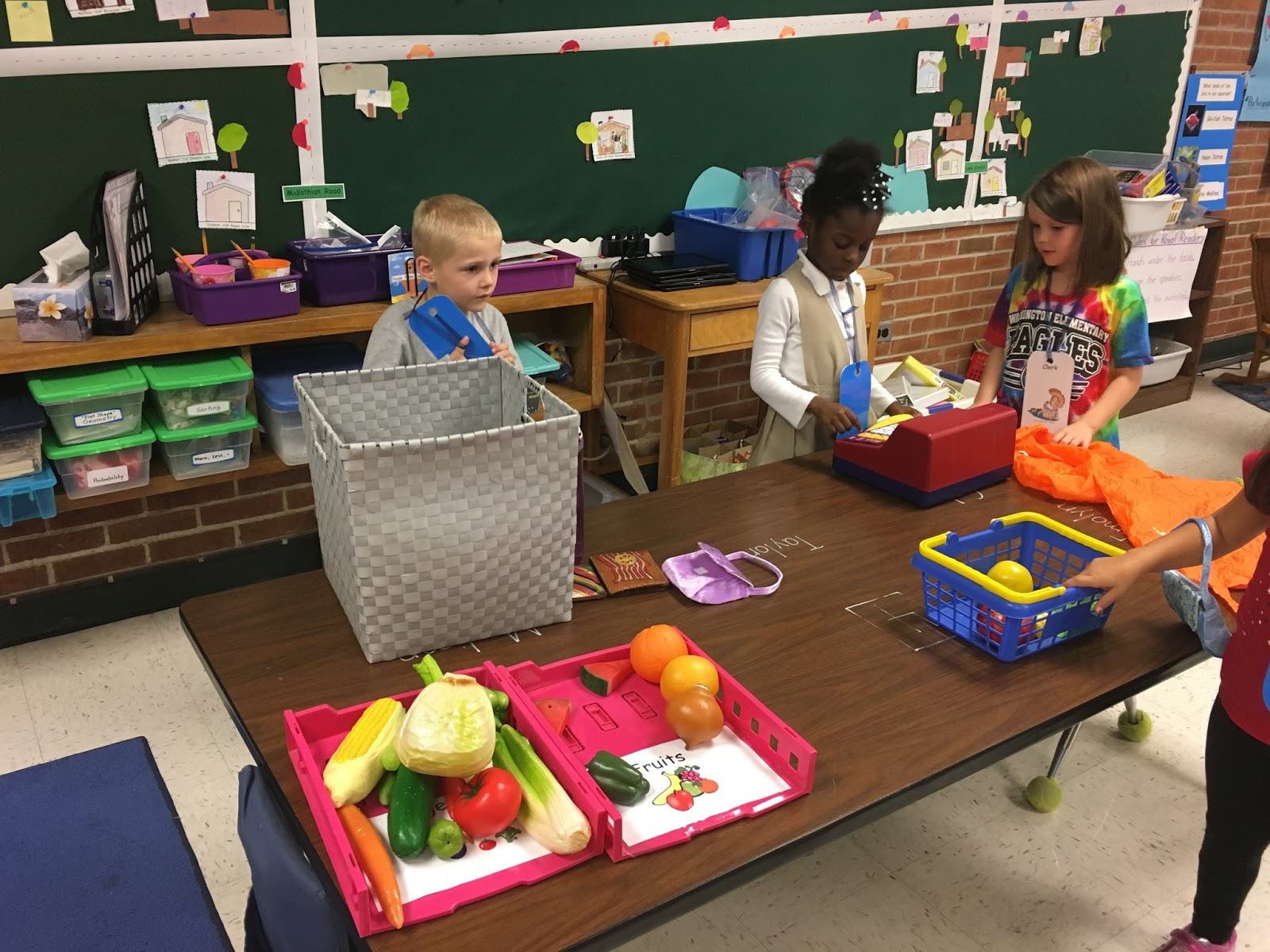
Fruit and Vegetable Stand:  Midyear, the kitchen becomes a fruit and vegetable stand.  I add a couple of recyclable bags, purses and wallets from the dollar store, and trays for sorting the fruits and vegetables.  I did buy a quality cash register , thinking it would be a nice toy some day for the grandchildren.  We have toy money in our math materials.  This center was really interesting for these older kindergarteners.

Dollhouse:  I had a lot of dollhouse furniture that I had saved from my own children's toys and earlier days in kindergarten.  I used scrapbook papers again to create flooring and then I laminated these pages.  The children lay out the flooring and then furnish each "room" before playing with the dolls.  Again, boys and girls both enjoy this kind of play.

Do I believe a quality kindergarten program should include this kind of play every day?  Absolutely.  Children need this time to develop social skills.  The pendulum swings in education; I'm sure the day will come again where children can play and play and play.


Friday, December 1, 2017

Creating Songs and Poetry Binders


Author unknown


I can't let the month of November go by without sharing one of my favorite kindergarten poems, November.  For many years now, this poem has amused my kindergarteners and me.  It has also led to good discussions about weather, seasons, months, hibernation and migration. Plus, it has helped us learn a number of important sight words.

I have been collecting and writing kindergarten-friendly songs and poems for most of my career.  Young children love simple tunes, rhymes, and rhythms.  They are motivated to read what they can sing and chant. To strengthen the connection, all of my poems/songs relate to the seasons, holidays, and kindergarten topics/themes.

I teach my class to read one poem/song each week.  They are either printed on large charts or shared on the interactive whiteboard. I laminated the charts until I realized that the glare off the lamination distorts the readability.
Here is the poem on the interactive whiteboard.


I also make two photocopies of each poem for each student.  One copy goes into a 1 inch thick binder. These binders are sent home with each student on Fridays.  At Kindergarten Orientation Day and at Parent Night, I explain how the students should read the new poem to at least three people over the weekend.  These people should sign their names on the back of the poem.  Binders are returned on Mondays.


The second copy of each poem is added to a 3-pronged folder each Friday.  These folders are kept in the students' book boxes.  My kindergarteners enjoy reading/singing the poems/songs to themselves and one another during Reader's Workshop.


We practice our poem/song daily for 5-10 minutes.  Here is what we do each day:
  • Monday:  I introduce the new poem/song by asking the children to think about the pictures and predict what it is about.  Then they put on their  "listening ears" as I recite/sing while pointing to the words.  The focus on Monday is on comprehension so we discuss what the poem/song means.  Then, the class tries to join me in an "oral choral" of the selection.
Holding our "listening ears" AND offering suggestions on what the poem means.
  • Tuesday:  We review what the poem/song is about.  I invite the class to join in reading/singing while I point to the words.  Then, we look for familiar sight words in the poem.  Until this year, we used wide yellow highlighter tape to highlight the known words.  Since I don't have to save these charts for future use, we are just using a yellow highlighter this year.  The helper is first to highlight a known word.  Other children raise their hand for a turn afterwards.  I also reveal the new sight word on Tuesdays: we match it to the word(s) in the poem, and highlight it wherever we see it, as well.
Matching a new sight word card to the word in the poem AND highlighting the sight word in the poem.

  • Wednesday:  Once again, I invite everyone to join in as I point to the words.  The helper also leads us by pointing while we are reciting. Then we do some word study of a phonetically-based word or words in the poem.  We use our whiteboards and markers.  For this poem, we practiced writing lower case "b" correctly in all the words starting with "b."
We always draw a sun and/or cloud in the upper left hand corner to help us write left to right.
  • Thursday:  After a few oral chorals of the poem on the chart, everyone gets to hold their individual copy of the poem  and practice reading it in unison.  First, they make a "pointer promise" ("I promise to point to the words.")
A pointer promise:
Hold your pointer finger in the air, saying "I promise to point to the words,"
then kiss your pointer.  
Friday:  We practice reading the poem on the chart a couple of times.  Then, we put the poem in our binders, highlight the sight words with our yellow crayons, and draw and color, as needed.


Next year, when I'm retired, I hope to publish my original poems on TpT. For now, Here is the November poem.  And click here for a copy of an original poem that I most probably will be using in December!


Wednesday, November 22, 2017

Should we teach kindergarteners about The First Thanksgiving?

Painting by Karen Rinaldo, 1994
We all think we know the story:  In 1621, the Pilgrims who survived the first horrible year in America held a feast where they gave thanks for the bountiful harvest and the help they received from the local Indian tribe.

This is the story that generations of Americans have learned.  As a child, I did not even know the name of the tribe that joined the Puritans at the feast; it wasn't until the 1990s that I learned it was the Wampanoag.  And, until I did a bit of additional research for this post, I did not know that the Wampanoag were not actually invited to the feast. They showed up, prepared for conflict, when they heard the "exercising of arms" that was all the shooting of fowl for the feast.  Nor did I understand that it became a diplomatic meeting, of sorts, between the Puritans and the Wampanoags.  Also, it's not likely that any Native women were in attendance, and the Puritan women and children would have been kept busy cooking, serving, and cleaning up. As for it having been a feast of 'thanks giving," the Puritans fasted--not feasted--on such days.  Read more about it here.

So, given the latest scholarship, should we teach kindergarteners about "the first Thanksgiving?"    And, if we do decide to teach it, what is the best way?

I am in favor of teaching American history to young children.  I believe it is our responsibility as public school teachers to help unify a diverse nation.  It is also our responsibility to teach the truth, however.  So, what truths can 5 and 6 year olds learn about the event that has become known as "the first Thanksgiving?"

Here are the key facts I've shared with my students this year.  I created flipcharts on the interactive whiteboard for some of the information and I'm including some of these images here, as well.
  • The Wampanoags lived by the Atlantic Ocean.  They built wetus, grew corn, hunted and fished.  They moved to a warmer place in the winter.  You can read more about how I taught about Native Americans in my previous post.
  • The Pilgrims left England because the king would not let them go to their own church.

  • They crossed the Atlantic ocean in the Mayflower.

  • Half of them died that first winter due to the cold and sickness.
  • The Wampanoags were troubled to see the Pilgrims settling on their land.

  • But the Wampanoags were kind and saw the Pilgrims were suffering.  They helped the Pilgrims grow crops.

  • In the fall, the Pilgrims had lots of food growing in their fields and decided to have a harvest festival.  They also wanted meat at their feast, so they hunted.
  • The Wampanoags heard all the "noise" of the feast, and the men decided to check it out. (Note: Here is where I decided to avoid the historical facts surrounding potential warfare.  Better to learn about that a few years further in their education.)  When they arrived and saw there wasn't enough food for everyone, they went out and hunted for some more meat to bring to the feast.
  • The Pilgrim women  and children did all the cooking, serving, and cleaning up.
  • The feast lasted 3 days.  Between meals, the Pilgrim men and Wampanoags tried to talk about sharing the land.  This was not an easy problem to solve.
  • The men also had races with each other.
I shared these books with my class.  Again, there is a scarcity of well-written, historically accurate books for this age level.  Given how very enthusiastic my students have always been about learning history, I wonder why more has not been written?
We made Pilgrim hats, bonnets, and collars.  There are many ideas of how to do this on Pinterest.  Here are pictures of my very simple projects.

Everyone makes a collar from white 12" by 18" construction paper.
I draw the lines and they cut it out.


I draw the biggest possible circle on 12" by 18" brown paper.  I draw and cut out the center inverted "U" shape.
The boys cut the big circle and glue a construction paper rectangle 'hatband' at the bottom of the pre-cut center.


The girls cut on the lines then I fold it up and staple it to look like a bonnet.  I add two 18 inch lengths of cloth ribbon.


Before Thanksgiving, we re-enacted the harvest feast/diplomatic summit of the Pilgrims and Wampanoags.  The kindergarten girls baked and served real cornbread to a few kindergarten boys dressed as Pilgrim men.  More of the boys represented the Wampanoag men because there were more of them present at the feast in 1621.  When the Wampanoags arrived wearing their beaded necklaces, they turned back to the "woods" to pretend to get some more food.  They then joined the Pilgrim "men" and were served cornbread, too.  After all the males were served, the Pilgrim "women" ate and cleaned up.  The "men" gathered in a circle to discuss the problem over land.  Then, they held a foot race (baby steps across the classroom floor.)


I loved the reactions of the kindergarteners!  There was some good, critical thinking happening.  Some of the girls were a little frustrated by having to wait to eat their cornbread.  Some wished they could sit with the boys. We talked about how girls have choices nowadays but they didn't always.  At first, the boys were a little frustrated that they couldn't work out the land problem.  Someone finally suggested sharing the land and living together would be nice. ( If only.... ) The boys really enjoyed the foot race and were happy when it was a tie between Pilgrims and Wampanoags.

Someone once told me that kindergarteners won't remember what I teach them but they will remember how I made them feel.  I hope this year's class will feel that history lessons are interesting and worth learning.  It's all about planting seeds in kindergarten....


Thursday, November 16, 2017

Native Americans, Kindergarten, and Me

Native Americans, Kindergarten, and Me circa 2002
How did I get it SO wrong?!  From the beginning of my career in the 1970s until the implementation of Common Core in 2010, I taught my students about Native Americans and the first Thanksgiving.  I helped the children make elaborate headdresses, constructed teepee dioramas and reading nooks, and made popcorn to share at a classroom feast. I perpetrated MYTHS! 

Here are some FACTS (myths debunked):
  • The Wampanoags, the Native American tribe living in the area prior to the English colonization, did not wear many feathers in their hair.  Read more here.
  • Teepees were the dwellings of the indigenous people on the plains; the Wampanoag lived in wetus, homes made of branches and tree bark. Find out more.
  • And popcorn couldn't be made from the kind of corn grown in the northeast. See this article.

Thanks to PBS shows and great websites like the ones in the above links, I know so much more REAL history now than I did at the beginning of my career. There were fewer resources earlier in my teaching career.  For the most part, I relied on the (erroneous) history I had learned during my own schooling.  

There was one concept that I always got right:  Native Americans are a living, breathing people.  I wanted my students to understand this fact at the very beginning of our studies.  Several times in the 1980s and 1990s, I contacted the American Indian Center in Chicago and asked them to send volunteers to talk with my students. Jenelle, a Potawotamie, visited my classroom two years in a row.  As a medicine woman in her tribe, she wore a jingle dress and showed us a healing shawl.  She also brought me gifts of an authentic dream catcher and rattle which I shared to the delight of my class for many years.

For the past six years, however,  I have not taught my students about Native Americans.  I could not find a way to fit this topic into our Common Core ELA units.  But this year, being my last year in the classroom, I wanted to revisit how to best teach kindergarteners about Native Americans and the first Thanksgiving.  I really wanted to get it right!  I wanted my students to understand that Native Americans are people whose families have ALWAYS lived in America and that they have a heritage that appreciates nature and crafts.  

Here is what I did this year in kindergarten "to plant seeds of understanding" in young minds:
  • I started our study of Native Americans in the last week of our communities unit.  In the first weeks of the unit, we learned about our own community which is a suburb of Chicago.  We discussed the diversity in our community during our Morning Meeting.  I pointed out that we had friends in our classrooms whose parents came from the Philippines, Mexico, India, and Bangladesh.  We found these places on the map and globe and practiced greeting each other in the languages spoken by our friends' parents.  
  • After a few weeks of appreciating the fact that many of our classmates' parents came from other countries, I sent home a map with each child and asked families to list and color in their countries of origin.  When the individual maps were returned, I colored in all of the different countries of origin on a large world map.  I explained that although most of our classmates parents were born in America, their grandparents or great- grandparents ( or great-great- grandparents) were not. 
  • Last week, I explained that there are some Americans whose families have always lived in America.  We call these people Native Americans. We watched a video about two present day Wampanoag girls who dressed in regalia and re-enacted life in a 17th century Wampanoag village.  This video is available to teachers who subscribe to Scholastic magazines.  My students loved this video and had much to say about it.
  • During our Morning Meeting, we practiced greeting each other using a Wampanoag word, pronounced wah-nee-kee-suck.
  • I selected a few read-alouds for the week which shared information about Native Americans.  Tapenum's Day by Kate Waters is very captivating.  Kindergarteners seem to understand a story is REAL when there are photos.  Also, if you want to get your students to ask questions, this book will prompt them. We read Thunder Boy, Jr. by Sherman Alexie to appreciate a modern-day Native American family.  I also shared how some Native Americans re-name their children as they grow older according to their talents or achievements.  My kindergarteners had lots of fun thinking up new names for themselves (Lots of "Fast Runner" monikers!) We read Nickommoh! by Jackie French Koller which describes a typical Narragansett harvest celebration, as it has been performed since before the arrival of the first Pilgrims in New England. That being said, there really is a need for more age-appropriate kindergarten literature on Native Americans.  
                         
  • At the end of the week, we made Native American drums out of cylindrical containers the children brought from home.  We decorated them with pictographs and patterns of circles to resemble beads.  We also made noodle necklaces (mix a few drops of food coloring in a tablespoon of rubbing alcohol and pour on a cookie sheet, roll uncooked mostaccioli noodles in it and let dry overnight.)  I know these crafts are "old school" but the 17th century Wampanoags did have drums and did wear beaded necklaces of various materials (I know, I know, not mostaccioli noodles.) There are lots of good math tie-ins with these simple projects, too: drawing shapes and making patterns.
  • Next week, we will have our own Nickommoh and wear our beads and play our drums.  We loved learning to read and sing "We are Native Americans" which you can view on youtube here.
  • When we have our Thanksgiving Feast, we will not be playing our drums because it's unlikely the Puritanical Pilgrims would have countenanced that.  More about our Thanksgiving Feast in my next post!
I'm not sure I have created the perfect kindergarten study of Native Americans yet. I have tried to be respectful of a living American culture and true to its history.  I do know that kindergarteners love learning about this topic.  One little girl keeps bubbling over with enthusiasm for the "Creative Americans," a passion that I share with her!